
The question of the patentability of inventions in the field of AI still raises many questions, even though such inventions account for a growing share of patent filings worldwide. At P&TS, nearly 30% of filings contain at least one artificial intelligence component.
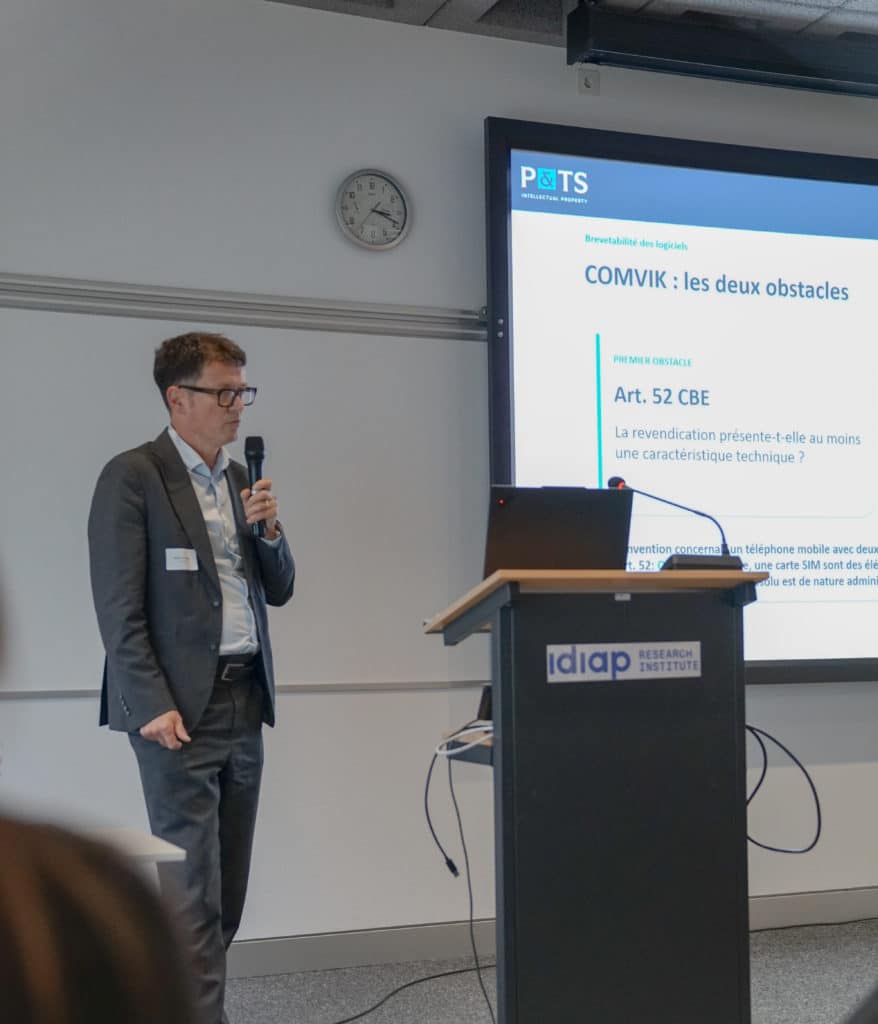
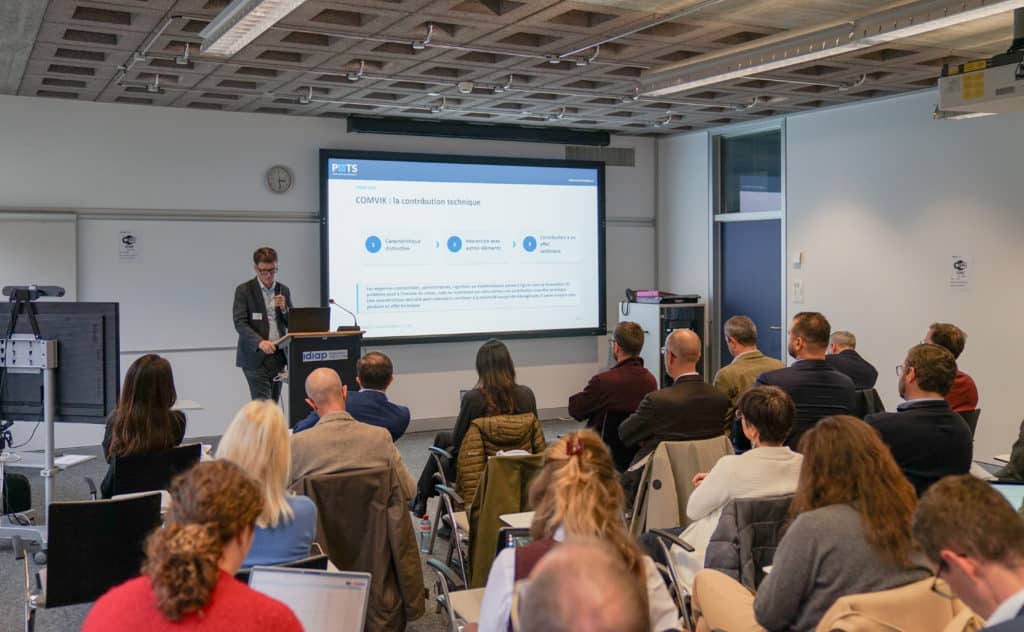
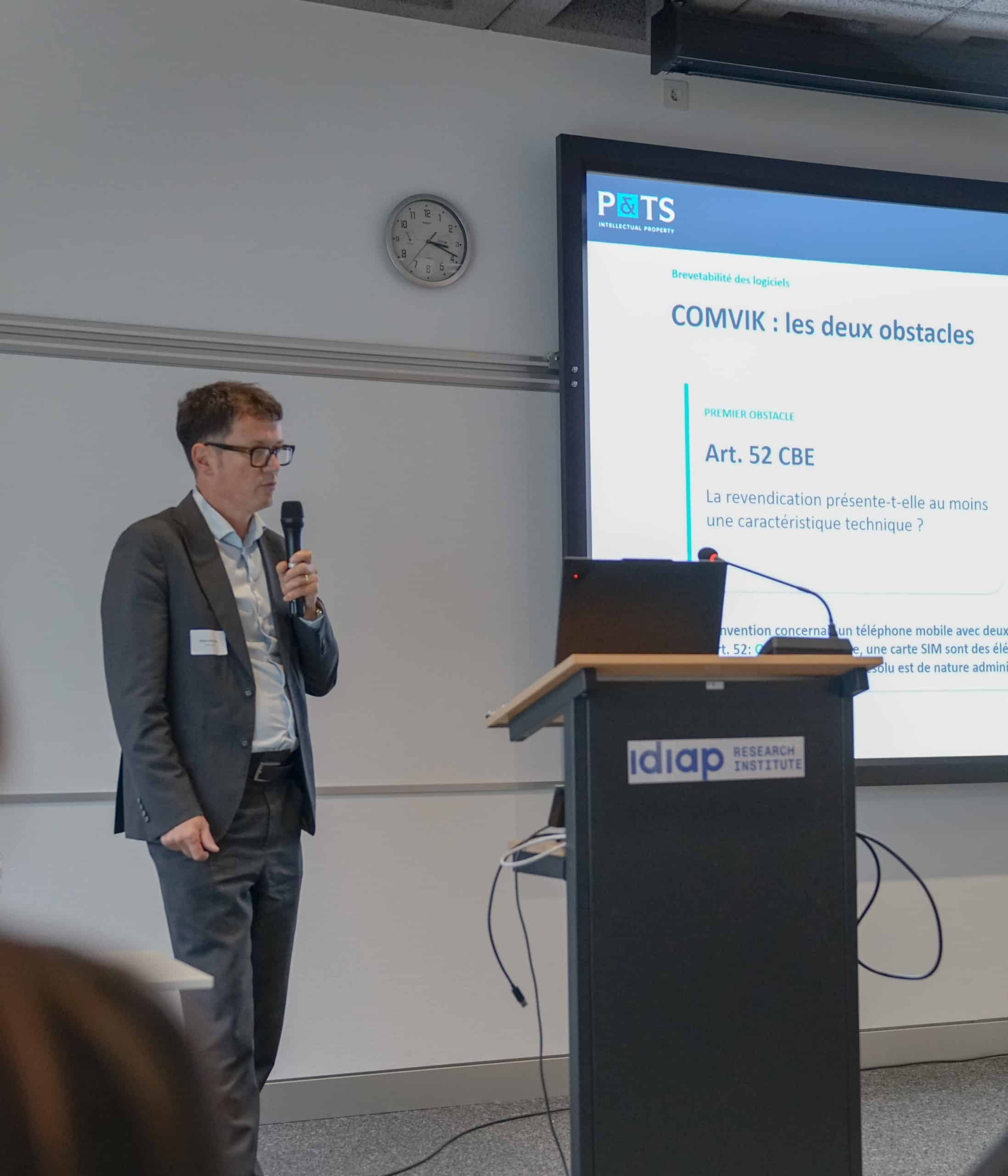
On 6 November, Christophe Saam, CEO of P&TS, presented the main challenges of this question at an event organised at Idiap in Martigny. He was accompanied by Adrien Marcone, Swiss and European Patent Attorney and specialist in intellectual property strategy for the digital world.
Presentation by Christophe Saam (in French):
Skip to PDF contentAn event bringing together AI and intellectual property specialists
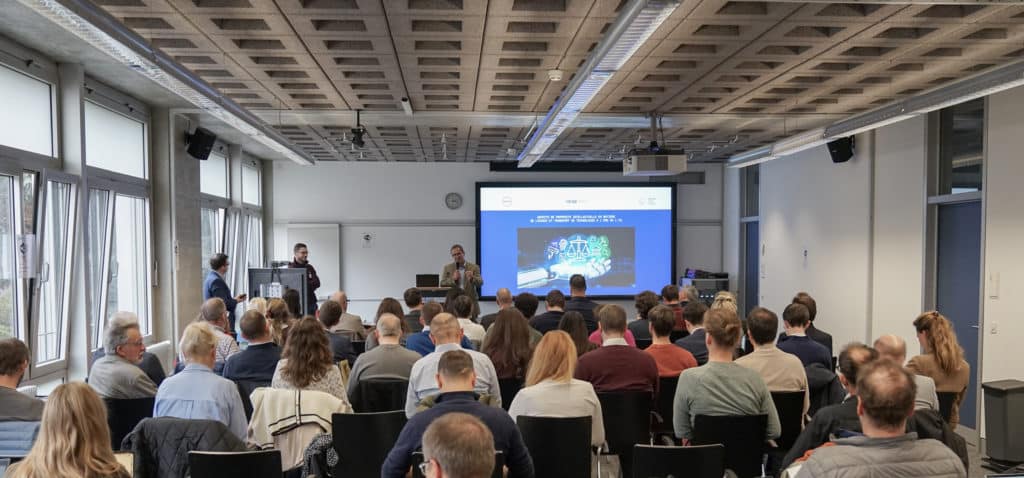
The AROPI (Association Suisse Romande de la Propriété Intellectuelle, in English: Western Switzerland Intellectual Property Association), the Idiap Research Institute and the DLC (Digital Law Center of the University of Geneva) jointly organised this half-day conference on the intellectual property aspects of licensing and technology transfer in the age of AI. It was a topic of interest: nearly 70 people attended.
The programme brought together speakers from a variety of backgrounds:
- Prof. Sébastien Marcel (Idiap) presented upcoming developments and challenges in AI.
- Dr Eva Cellina (DLC) addressed best practice and current issues concerning AI licensing agreements.
- Christophe Saam (P&TS) spoke about the patentability of inventions in the field of AI.
- Alexandre Nanchen and Aïda El Faiz (Idiap) presented best practice and current issues concerning technology transfer agreements in AI.
- Prof. Yaniv Benhamou (DLC) spoke about open source contracts and the spread of free licences in the age of AI.
- Sébastien Ragot and Daniel Campanario (E. Blum & Co.) presented the use of AI in intellectual property consulting and the “Guidelines” project.
Technical character, the central criterion for the patentability of inventions
Christophe Saam first recalled that a patent can be filed for an invention that uses AI, provided that it has technical character. Identifying this can be complex and may not be obvious, as he illustrated with two examples:
- An invention with technical character: an AI-based statistical method assesses the risk of diabetes. A neural network processes glucose measurements and produces a risk score. The model uses physiological data to assess a state of health. The technical effect lies in the analysis of a bodily parameter for medical purposes.
- An invention without technical character: a neural network processes the image of a web page in order to determine whether a given advertisement is relevant to that page. The neural network and the image processing do not change this: the question being addressed remains “where should an advertisement be placed?”. The aim is commercial, not technical.
In summary: the nature of the data is not enough. What is decisive is the technical purpose.
Beyond the patent: the value of training data and trade secrets
The protection of an invention that uses AI is not limited to patents, as is the case for any invention. In this field, the competitive advantage often comes from the quality, selection, annotations and history of a corpus of training data. However, a corpus is not a patentable invention solely by virtue of its economic usefulness.
Other rights may apply depending on the case, such as the protection of trade secrets, copyright or the sui generis database right in the EU.
Switzerland and Europe: an evolving framework
In Europe, the European Patent Office (EPO) states in its Guidelines for Examination that a patent may be granted where AI is applied to solve a technical problem in a field of technology. This is precisely the criterion of technical character, as presented above in the two theoretical examples.
The Unified Patent Court (UPC), of which Switzerland is not a member, aligns with the EPO through the “COMVIK approach”: only the features that contribute to the technical character of the invention are taken into account when assessing inventive step.
In Switzerland, the Federal Patent Court also follows this approach. The Swiss Federal Institute of Intellectual Property (IPI), on the other hand, takes a holistic approach in which the presence of a trivial technical element is not enough to establish the technical character of the invention. A patent application may then be rejected before its inventive step is even checked.
An appeal is being examined by the Federal Supreme Court to settle this question, which is essential for the Swiss software industry. In addition, the revised Patents Act will enter into force on 1 January 2027 (see our dedicated article). Christophe Saam hopes that it will bring greater clarity on the patentability of inventions involving AI.
Conclusion
Traditional intellectual property tools, mainly patents and copyright, also apply to inventions in the field of AI. These inventions nevertheless have specific features, foremost among them the value of training data, which requires other, complementary types of protection or contractual measures to preserve confidentiality.
At P&TS, we protect inventions that use AI comprehensively. To do so, we draw on both intellectual property instruments and our expertise in IT and AI law.
This article is an automatic translation of the French original.